Exhale Longer

I’m in the last semester of a doctoral degree program. There’s some stress involved in thinking about wrapping this thing up. It is exciting, and also, there’s a lot of reading, writing, and refining left to do. I’ve got Lorelei and the kids, I’ve got work, I’ve got family and friends, and I’ve got all kinds of things I’d like to be doing, like waking up early to exercise every day, like writing every day, like rebuilding the bedroom closets for increased efficiency, and so much more. All of these blessings are present in my life and in our lives. Truly blessings, these pieces of our wonderful puzzle are also stressors present in all our lives.

During class this week, our professor (well known for her expertise in the area of mindfulness) reminded us that if we’re under a lot of stress we can cut that stress by being intentional about our breathing. As you know, intentionality around breathing is a thousands-year-old, proven-effective strategy for promoting calm, thoughtfulness, peace, and productivity. When we do it right, we find that it works. It really does work. You gotta do it. And when you do…it works.

While remembering that an intentional focus on breathing works, we should also remember that it’s not a cure but a practice. Stress surrounds and inundates all of us. Sorry to burst your bubble, but practice doesn’t make perfect. It never has. There is no perfect. As a dear friend and colleague of mine repeatedly reminds us, practice makes progress. We’re looking for progress.

Intentional breathing (similarly to every other mindfulness practice) will not make it so that you no longer feel stress. If done right, it can help you navigate stressful times in positive and healthy ways. It can remind you of your growth mindset and reassure you that better times can, and will come. It can remind you that you are strong and that you can handle anything that comes your way.

I did a bit of digging. The best I could discover is that the longer exhales activates the parasympathetic nervous system (whatever that is), and that longer exhales stimulate the vagus nerve (whatever that is), which helps slow your heart rate, remind your brain that you’re safe, and moves you out of a “fight or flight” anxious state into a “rest and digest” calm state. Pretty cool.

Sometimes when I’m really stressed, especially when I feel stuck in it, I make choices that don’t represent my best self. Sometimes in that state I can be argumentative and grumpy, I can eat too much of the wrong things, I can avoid, and I can spend my time doing things that don’t really matter to me or bring meaning into my life. When I’m at peace and relaxed I tend to make better decisions, I tend to behave in ways that I’m proud of, and I tend to be holistically better for myself and for those around me.

The other day I hear a scientist say tonic decisions release tonic chemicals inside of us, while toxic decisions release toxic chemicals inside of us. Tonic versus toxic. Healthy versus unhealthy. What do you want to be? Think about making your exhales a bit longer than your inhales. If it works for you, keep doing it. Maybe it will help. If not, all that’s happened is you’ve spent a bit of time being intentional about your breathing. Truly, nothing to lose!

Live. Love. Listen. Learn. Lead. Thanks.

Splashes, Ripples, Calm and Clarity

There’s a mindfulness analogy that lands very true on me. We see more clearly through calm than through clutter. The reference is of a body of water. I think about the small river the feeds into the big lake in the sleepy Northern Michigan town my family calls home when we’re not at home in metro Detroit.

The river is probably fifty to one hundred feet across at various points. It goes to about waist deep where kids swim and probably about shoulder deep in the reedy parts under the bridge. I wouldn’t know for sure because I wouldn’t stand in that part. Too mucky. Too slimy.

Even on a windy day when the big lakeshore is pulsing with whitecaps, the small river is generally still. The small river is still because it’s nestled between tall growth on either side. It’s sunk low beside the sleepy town. On the main drag you look across the small river and on to the big lake as you walk the path from town to beach.

When the small river is still (which is most of the time) you can see straight to the bottom, even from up on the bridge. When the surface is calm, you can see long green plants slowly swaying as schools of curious fish glide and flutter between them. Occasionally a big fish or a turtle floats along, seemingly paying no attention to the schools, and seemingly having no attention payed to them.

There’s a world beneath the surface of the small river. Plants and animals are living their lives, probably with no knowledge that they’re being watched from above. Most likely never knowing that they catalyze our imaginations, that they inspire our reflection, that they feed our curiosity, and that they ignite tangential patterns of thought in us.

Most of the time we can see the world beneath the surface of the small river with incredible clarity. We can see beneath the surface with such clarity because generally, the surface of the small river is still. Most of the time, the surface is calm.

Sometimes it’s raining. Sometimes kids are splashing one another or throwing sticks and rocks into the small river. When the surface is disturbed we can’t see beneath it. When the surface is not calm, when it’s cluttered with splashes or ripples, one would never know that there is a world beneath it. One would never know about the plants and the animals who have the power to inspire us, to catalyze thoughts, and to initiate reflection.

Our minds are like the surface of the small river, and like the surface of any body of water. We see more clearly through calm than through clutter.

Whipped Cream or Velvety Milk Foam?

Perception is reality. Not actually, but to the perceiver. 

Human brains do this funny thing. Our brains allow us to believe things we need to believe. They allow us to believe things we want to believe. 

We were at our favorite coffee shop. 

It’s our favorite because it has a bustling, city vibe. We like the action. We like being around people while they talk, work and laugh with one another. We like the modern music, written and performed by obscure artists playing moderately softly in surround sound. We like that the wall of street level windows displays the world outside to us, and that it displays us to the world outside. 

I was with our 9 year-old. I got coffee. He got hot chocolate.

The hot chocolate at this coffee shop comes with a layer of velvety milk foam on top. The baristas pour it like they pour lattes. They are milk foam artists. You get either an image of a decorative flower or an image of a decorative heart on the surface of your drink. It’s lovely. 

It’s sweet, creamy and delicious. 

Our 9 year-old called it whipped cream. I corrected him. “It’s velvety milk foam,” I explained. 

“It’s whipped cream,” he declared nonchalantly.

I looked at him. I furrowed my brow and smiled. With a bit of a chuckle I once again offered the truth I was certain of. 

“It’s velvety milk foam,” I reiterated.

He furrowed his brow and smiled in parody-laden homage to my furrowed brow and smile. Then he returned the reiterative favor by plainly stating, “It’s whipped cream.”

We both laughed. Something we do quite often when we’re together. 

We never did settle the matter. Doesn’t matter, though. To me, it was velvety milk foam. To him is was whipped cream. Perception is reality. Either way, it was sweat, creamy and delicious.

As educators, parents and caregivers we often find ourselves in situations where the reality of our perceptions doesn’t exactly match the reality of our kids’ perceptions. How do we wade through varying perceptive realities to get to the outcomes we’re looking for: safety, health, learning, joy, balance, etc.?

What if we prioritize the outcomes over the details and the differences in perception? What if we put our energy into exhausting the dialogue with outcomes in mind? What if we engage our kids in exhaustive dialogues, model tools and strategies that can help them share thinking in compassionate ways, and support them in problem solving and planning?

Nothing about raising and teaching kids is fool proof. In my experience, when we sort through challenges with an eye on coming together around positive pathways forward (rather than making our points about perception and reality), restorative, growth-producing and relationship-building outcomes seem to be enhanced. 

Whipped cream or velvety milk foam? We never did come to an agreement. 

What we did was sit for a while at our favorite coffee shop, chatting and laughing, observing the world around us and connecting with one another, taking advantage of the gifts of family and leisure time. Incredible gifts that I am incredibly grateful for. 

Our perceptions were the same about that.

Besides, without being able to agree on what it was, whatever was on top of the hot chocolate was still sweet, creamy and delicious!

Live. Love. Listen. Learn. Lead. Thanks!

One of my Daring Days

Our 12 year-old recently said to me, “Today is one of my daring days.” I don’t remember the context.

There was something to overcome and he overcame it. It might have been an orchestra concert to perform in or a tennis match to play. It may have been connecting with a new friend or sharing thinking in class. Regardless, “One of my daring days” stuck with me.

At 12 years-old he understands and can articulate that some days are daring and others are not. He knows that courage isn’t at the ready all time, but a character strength we have to understanding and intentionally enlist. He know’s even thought is’t not always available, that daring is accessible to him. He had access to it on that day and he recognized that access. I believe this sensibility will allow him to have increasingly more daring days, along with more automatic access to them as he grows. He seems to like the feeling. I was thrilled he mentioned it.

In mentioning it, he reminded me that while daring days are wonderful, some days are not daring days. Some days are cautious. Some days we get stuck in fear and find ourselves unable to move. He reminded me it’s ok to live some days within our comfort zones. Even to live some days regressed and motionless. Sometimes I feel like I can conquer any fear and travel any distance. Sometimes I feel locked in place. Human. 

Change, while essential and inevitable, requires daring. Even positive change. Change is wonderful and exhilarating. Change is also loss. Even when we change for the better, the better replaces what was in its place. Whatever was there before the better might not have been as good, but it may have been comfortable. 

“Better,” even though it’s better, can be scary. When we change for the better it often feels like we are then responsible for maintaining. Can we be expected to be our better selves indefinitely? What if we mess it up? There’s lots of pressure in change. On daring days, the motion of change, the growth that accompanies it, and even that pressure can be exciting. 

Our 12 year-old knew he was having a daring day. The possibilities were boundless. After the first daring thing he decided to do more daring things. He told me it was a daring day while we were driving toward home. After he told me he mentioned he was going to write when we got home. If you’re a writer you know it can be a daring thing to do. He was teaming with ideas and enthusiasm. He enlisted the daring he found access to. He maximized its benefits while they were in front of him. 

It’s ok to have days that are not daring. When we do have days that are, we should harness them. We should take action and make plans. We should specifically plan for open-hearted self love and for grace in the knowledge that we will continue experiencing many types of days, and that each one it gift; days we soar, days we doubt, days we show up, and days we hide. Each is a gift. Each has value.

We should ground ourselves in reality by being intentional about identifying our daring days, taking advantage of them, and settling in comfortably to the notion that our moods, our energy and our capacity to engage courageously in the world, both inside and around us, is subject to ebbs and flows. 

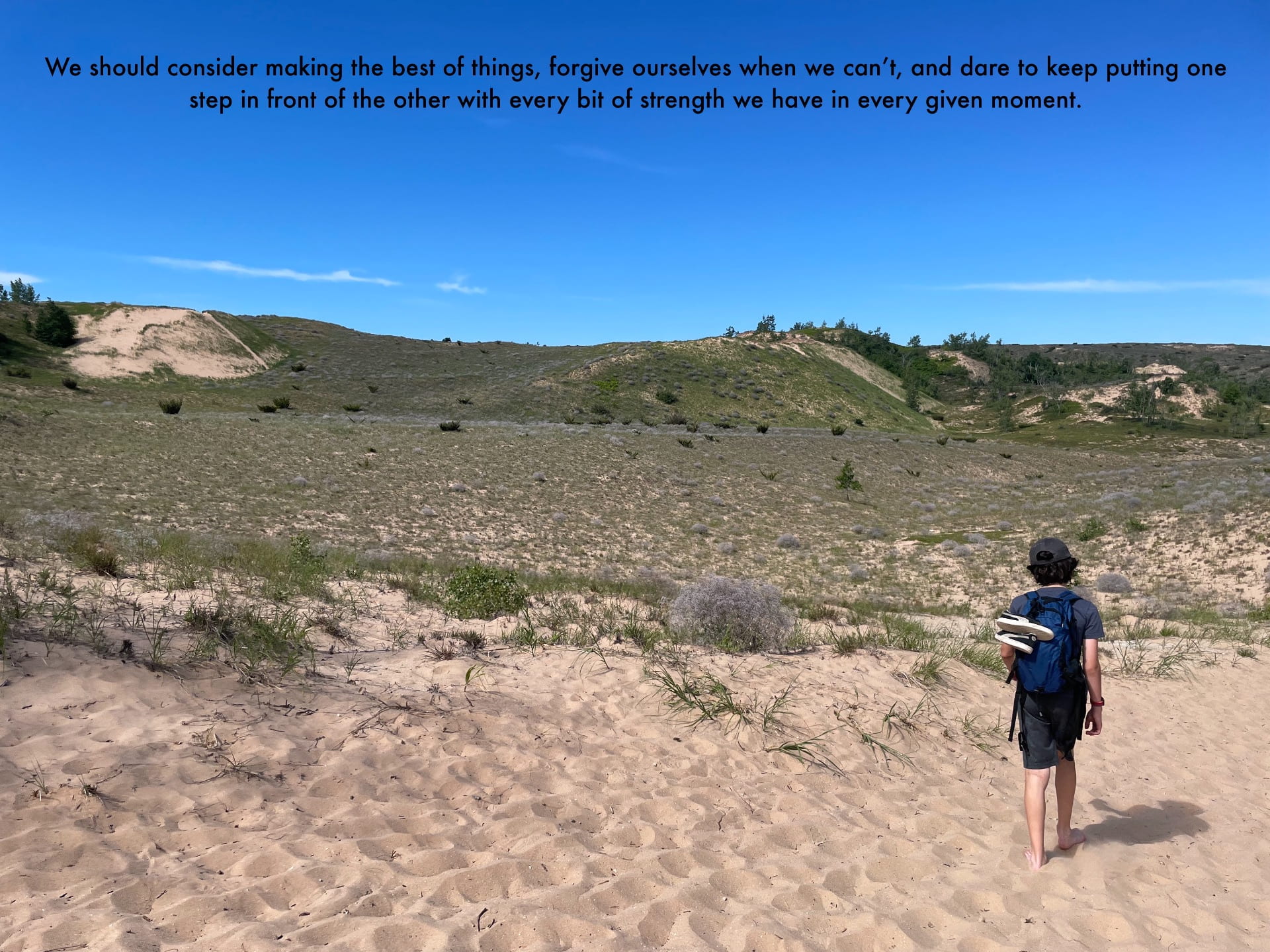
It is said that happiness does not come to the person who has the best of everything but to the person who makes the best of everything. We should consider that as best be can, forgive ourselves when we can’t, and dare to keep putting one step in front of the other with every bit of strength we have in every given moment.
In it together for the kids. 

Live. Love. Listen. Learn. Lead. Thanks.

Awareness as an Anxiety Antidote

When the past and the future are out of mind the present is available. That’s why our breath is such a wonderful tool. Our breath is here now. Breathing is what we do in the moment. There is consistency and certainty in our breath. While we live and breath, our breath reliably moves in and out of our lungs. Unlike the many less connected facets of our daily lives that drive uncertainty and plague us with worry, doubt and fear, we can depend on our breath for comfort. 

When we focus on our breath we are focusing on our vitality. In that way, we can use our breath to be aware of reality in real time. Because anxiety is often based on unfounded, even fantasized accounts of the past and fictionalized predictions about the future, awareness of reality in real time can counterbalance it (anxiety, that is). 

Habitual awareness can serve as an extended antidote, diminishing the worry, stress and myriad other negative impacts associate with habitual anxiety. We are each already in the habit of breathing. Broadening the habit to a focus on our breath as we breath can have immediate positive implications on our behavior and long-term positive implications on our well-being.  

Over the past couple of decades I’ve exerted considerable effort and spent loads of time exploring and practicing strategies aimed at finding calm in the eye of the storm. So much time and effort that you’d think I’ve perfected it. Yeah, right. Come to find out, while most of what I’ve learned and relearned is based on a combination of awareness and common sense, it may still be a lifelong pursuit. Even as you read this reflection you may well recognize I’m not referring to anything you don’t already know. Especially if that’s the case, you also understand that knowledge and practice often sit at distance ends of a deep divide.  

That said, in my experience (and according to every philosophy, methodology or program dealing with problem solving, crisis management or deescalation I’ve ever come across) calm continuously surfaces as the ideal posture for maximizing safety, productivity and progress during stressful events or periods of time. Calm is a catalyst to well-being. 

This exploration of calm has been based in large part on the path I tread as a husband, a parent and an educator, it’s predicated on a desire I’ve long held to relieve the feelings of worry and stress I periodically (and sometimes habitually) fall into, and it is now proving as important and opportune as ever during a time when I see and feel a great deal of anxiety swirling around me, seeming to have a deep and determined impact on an enormous swath of the children I serve and the adults I partner with in that service. 

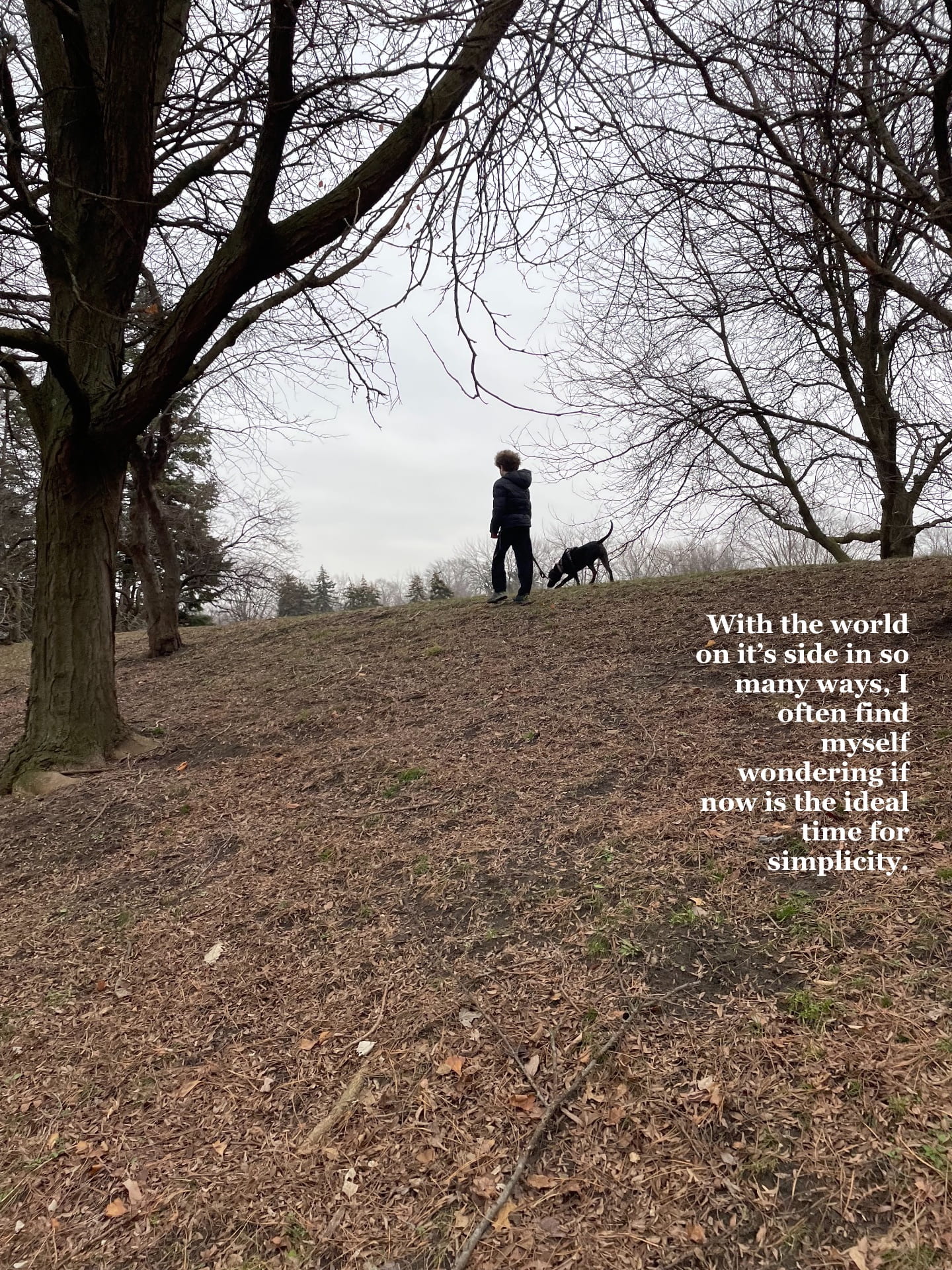
With the world on it’s side in so many ways, I often find myself wondering if now is the ideal time for simplicity. The challenge is, simplicity isn’t easy.

Timelines and obligations are real. The sun rises and sets, and in between those two events we do have to get certain things accomplished. How much time, though, do we spend toiling in worry? How frequently do we think about and relive our regrets, fret over the lack of progress we’re making on a task or a project, or doubt our ability to meed a target date? How often do we stand by while that thinking, reliving, fretting and doubting seizes our minds and our hearts? How much time do we spend outside of ourselves, watching as we perpetuate extended cycles of worry? 

What if we used the same amount, or even a fraction of that time for a focus on awareness? Without even considering a shift in how we feel or how we behave, could a simple shift in how we watch and listen to ourselves support increased well-being? 

What if instead of perceiving ourselves from the outside, as spectators, we intentionally kept and eye on ourselves from the inside? What if we zeroed in on our thoughts and feelings by way of a straight forward, pretense-free focus on our breath, even thoughts of and feeling around worry and stress? What if we accepted and attended to those thoughts and feelings with curiosity and kindness, not asking why but rather how it feels to feel the way we feel? 

Instead of considering what we can do to feel better, what if we could be calm and aware enough to simply ask ourselves to identify details about the thoughts and feelings we have while we are having them? What if a focus on our breath could help us? What if being aware could promote genuine learning and growth? A simple (not easy) path that, with practice and dedication might have the potential for prolonged and universal application and impact. By the way, as you know, breath as mindfulness tool is a centuries old concept that has had an incredibly  meaningful impact on the history and progress of humanity, across a multitude of regions, cultures and theologies.

Dr. Judson Brewer wrote a wonderfully thoughtful and well-researched book called, “Unwinding Anxiety: New Science Shows How to Break the Cycles of Worry and Fear to heal Your Mind.” In it, he points to habit loops through a reward-based learning paradigm as the basis for persistent entrenchment in anxiety. He recalls anecdotes from his research lab and clinic and puts forward simplified explanations of neuroscience to point out how we get ourselves stuck in habit loops through triggers, which catalyze behaviors and produce results that trick our brains into thinking some relief is at hand.

For example, if I wake up in the middle of the night feeling panicked about the uncertainly of a busy week ahead I might start making mental plans or checking emails. While planning and checking emails may give me a moment of relief and distraction from the worry, those behaviors are also likely to open the floodgates of stress and trip the signal wire for a worry habit loop. Dr. Brewer might map it like this:

Trigger: Middle of the night panic

Behavior: Planning/checking emails

Result: Temporary relief from immediate worry/perpetuation of extended stressfulness and possible trigger for additional feelings of panic

Alternatively, I could focus on my breathing (consistent and comforting) and turn into the  feelings of panic with awareness, curiosity and kindness, asking my mind, my heart and my body to describe what they’re feeling. I could live in the moment, accepting the situation, exploring what’s happening, allowing myself to spend time with with the panicky feelings, and providing my brain with some important data about how I process stressful situations.

I may not magically feel relieved from the panic and be able to quickly go back to sleep, but in theory, this alternative behavior could help me find pathways to breaking worry habit loops, not necessarily because I’m searching for those pathways, but simply because I’m developing a deepened understanding of myself and my capacities. Again, not easy but simple. 

Jon Kabat-Zinn, author of the mindfulness standard “Wherever you go, there you are, reminds us that while being aware (specifically through the practice of mindfulness) is challenging work, it is worthwhile and growth-producing in that, “it literally allows us to see more clearly, and therefore come to understand more deeply, that which we were out of touch with or unwilling to look at (p.8).”

We are living through waves of trauma. If you, your kids or anyone around you are experiencing negative impacts from situational or extended anxiety, an intentional and dedicated focus on awareness through mindful breathing could be a step in the right direction. None of us wants to suffer. We are better for ourselves, the kids we serve and the adults we serve with when we’re clear-headed and calm. Face the challenges, celebrate the triumphs and approach stumbles and roadblocks with forgiveness and loving kindness, for yourself and others. 

It’s a journey for us all. One step at a time, with intentionality and togetherness we are strong. 

Thanks for reading…in it together for the kids!

Live. Love. Listen. Learn. Lead.

You Can Tell Me What The Speed Limit Is

A Scenario 

We were in the car the other day. It was a great day. It was one of those days we spent together from start to finish. Everyone got along. The 7 and the 8 year-old started playing immediately. It’s not that they never do this, but sometimes they wake up at odds. Sometimes one want’s to go downstairs and the other wants to stay upstairs. Sometimes one wants to watch a cartoon and other wants to watch a baking challenge. Sometimes one wants some space and the other wants to wrestle. 

This time, they hopped out of bed and got right to it. The 7 year-old was in our bed because he got up a bit early, but right when his big sister woke up she came to get him. She asked if he waned to play and this time he did. The stars aligned. They spent the next hour or so in their bedroom; imagining, laughing, encouraging and playing. 

After breakfast we decided to take a day trip. It was book stores, playgrounds, soccer balls, basketball and jump rope. We told stories, played games and had fun. 

There we were, on our way to another location for more family fun, when he turned to her and said, “You know, you should live with me when we grow up. That way, when we’re driving around in the car you can tell me what the speed limit is.” 

Keen. Even though he’s 7 years-old I’m confident he knows that the speed limit is posted. In that moment I had the sneaking suspicion he was actually telling his big sister that he loves her. I suspect he was giving her some insight into the joy he feels that they have one another, the understanding he has of their unconditional bond, and the vision he holds of their connected life. I don’t know that he actually believes they’ll live together, but it seems that he believes they will alway be friends, confidants, playmates and partners in life. It was a nice moment for me. 

I grew up with five siblings, each of us less than two years apart in age. Lorelei and I have been incredibly blessed to be able to build our family in this way. In large part, we planned for four close-in-age siblings so that they would each have the others for a lifetime of comfort, support, encouragement, celebration and unconditional love. 

Siblings don’t always get along. Heck, we don’t always like one another. There are ebbs and flows. However, in my experience, there is never a time…not a single moment, when siblings are not connected. I believe that anyone of us would tell any of the others what the speed limit is anytime there’s a need, without hesitation. 

My heart was warmed to hear the big guy connect with his sister in that way. 

Two Possible Implications

We’re on winter break. Life is really busy and really challenging right now. It’s difficult to keep our kids’ days filled with routine, normalcy and comfort. We see the trends and we hear the news. On all fronts, from community health to politics we need to navigate decision making for ourselves and for our kids, while providing them with just the right developmentally appropriate information to keep them balanced, reflective and joyful. They are kids, after all. Even in an imperfect world, they should be joyful. 

Consider the following possible implications drawn from the scenario above: 

Long-term social bonds are critically important to our kids’ well-being. 

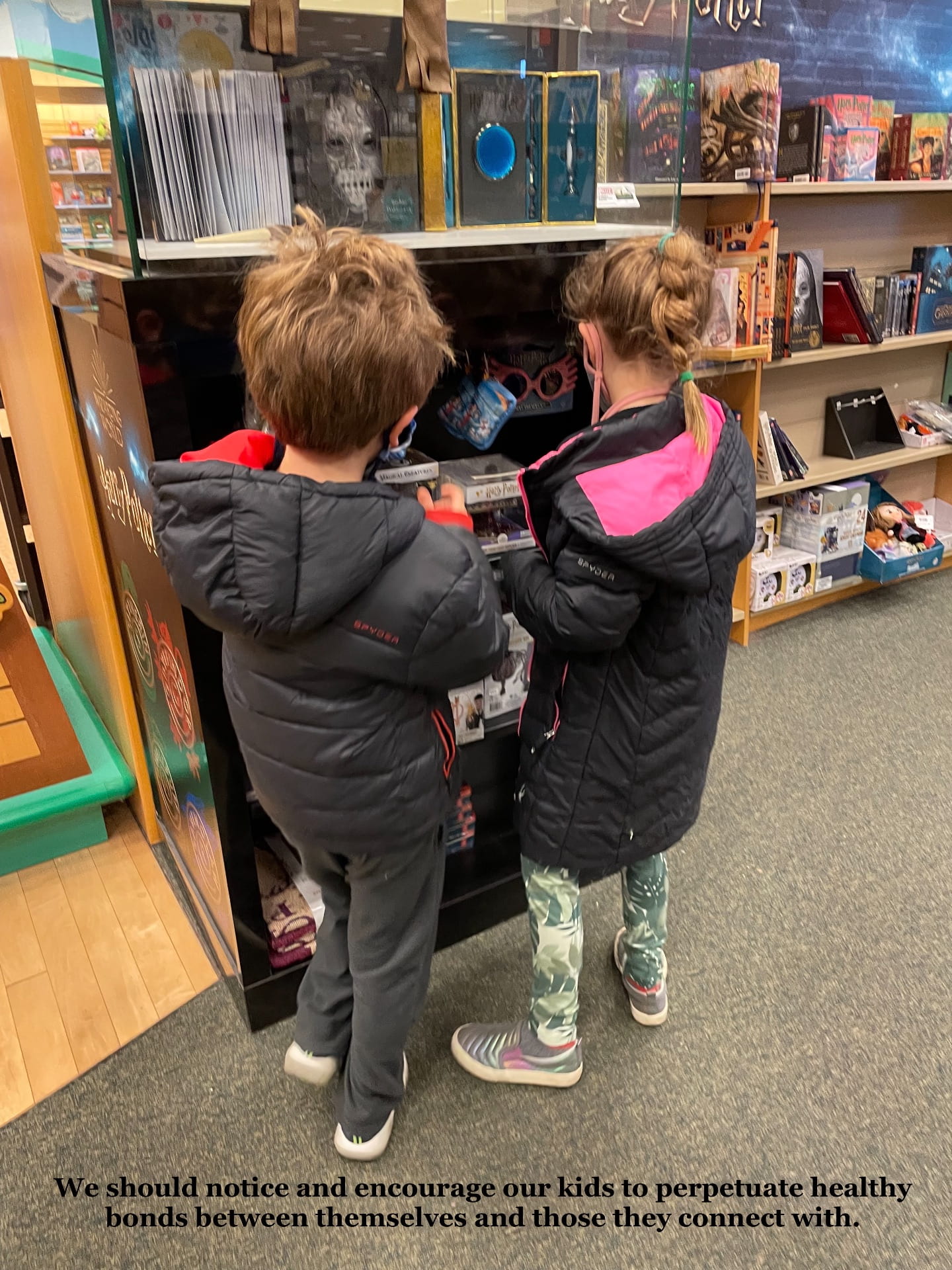
As we guide our kids through the strange social landscape of a pandemic we should keep an eye on their friendships. Whether we’re looking at friendships between siblings, other relatives, school friends or kids in the neighborhood, we should notice and encourage our kids to perpetuate healthy bonds between themselves and those they connect with. We should help them make time to spend together. When needed, we should guide them in social conflict resolution while reminding them of the joy they feel when they are together with people they appreciate and understand, who also appreciate and understand them.

Our kids prompt one another, and us. 

This time, the 7 year-old prompted his sister to continue connecting with him. Sometimes the prompt is that he needs space. Kids do this to one another and they do this to us. As a grown up he will easily be able figure out what the speed limit is without assistance. They both know this, but he wanted her to know he needs, and will continue to need her. 

We should keep an eye on the language our kids use with one another and with us, so that we can support their needs in any given moment. When kids ask for our help with things they know how to do or can handle on their own they may simply be asking for some time together, or an acknowledgement of the bond we share with them. They may be reaching out with a message of togetherness or a request for comfort. Reading and responding to such prompts is well worth the time, every time. 

An Activity

What implications do you see? What learning can you discern from this scenario? Take a moment to reflect and consider a parenting/education guiding principle the “speed limit” anecdote brings to light. Share your thinking, with me or with anyone you turn to for processing along this unique and wonderful journey. You can use the “comments” section below if you’re so inclined. There is meaning to be found in even the smallest moments. Look and listen with an open heart and on open mind.

Thanks for reading…in it together for the kids.

Live. Love. Listen. Learn. Lead.

…and take.

We’ve been giving for while now. Parents and educators, we’ve spent the last couple of years pouring ourselves into finding ways to provide safe spaces within which our kids can learn and grow. We’re happy to do it and we will continue. Still, it’s hard…something we don’t always admit or take into account. 

We’ve tried with all our might to provide our kids with consistency and routine. We’ve found ways to let them be kids during a time that we didn’t see coming and often struggle to understand. We’ve seen the world shift in unthinkable ways. We’ve all been washed over by waves of trauma. Still, we continue to employ every ounce of our energy on behalf of a joyful and balanced childhood for our children. 

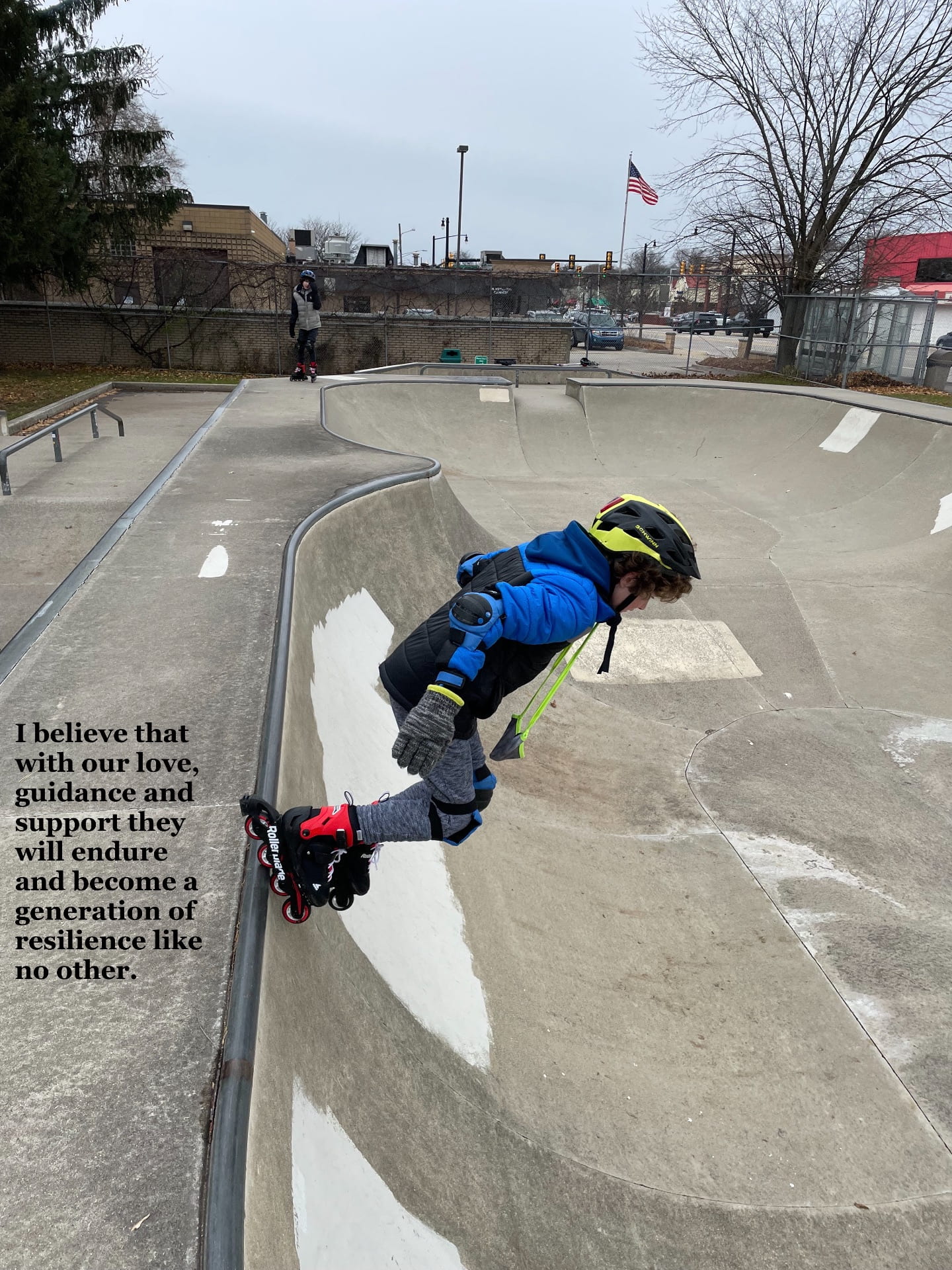
Through cavernous ebbs and unrestrained flows, we’ve realized that there has always been good to find, and with that realization we continue to find it. We’ve faced challenges with courage and grace, and we’ve celebrate triumphs with delight. I have no doubt that we will carry in this way. Our children are in good hands. I believe that with our love, guidance and support they will endure and become a generation of resilience like no other. 

Ironically, in this season of giving, I would suggest it’s now time to take.

Parents and educators, take a breath. Take a moment to relax. The work will be there when we return to school in the new year. 

Take self-care seriously. Start that routine you’ve been meaning to start. Get into a habit. Exercise each day. Take a walk. Take time to prepare healthy food and eat with meals with your friends and family. Take the liberty to eat some meals by yourself if you’d like. Enjoy every bite. Take trips to places you love. Take a nap. Take a step out of your door when the sun is shining, just to feel the warmth on your face.

These days can be wild and fast. A break is a blessing. Whatever urge pulls you to linger in hurried thoughts, whatever sense tries to trick you into sleepless nights, whatever confusion attempts to distract you, deny it. Deny it all. You’ll have plenty of opportunity to twist, turn and toil again very soon. For now, take what you know you need. Take what you know will help you continue to be strong in the coming days, weeks and months. 

Just like we give tirelessly for the kids we serve, take for them now. It will benefit them as much as it will you. It will allow you to regenerate into your best self. It’s time for balance. In the great give and take of this extraordinary ride, it’s time to take.

Thanks for reading…in it tougether for the kids!

Live. Love. Listen. Learn. Lead.

When It’s Just You And Me I Feel Like I Won Something

The end of the year and the holiday season can feel like an emotional rollercoaster. There’s so much to do, we’re exhausted, and let’s face it parents, guardians and educators…we have really high expectations of ourselves (sometime unrealistically high). I know a way to help relieve some of the stress of the end of the year, holiday season emotional rollercoaster. The challenge is, in order for it to work, you have to actually do it. 

Cast your mind to something that brings you joy. Imagine you’re in a place where you experience peace and balance. No matter what struggles persist in any given moment, we all have memories of good things. 

Is it making pancakes with your kids on a snowy Sunday morning? Is it a walk with your dog on a lazy afternoon? Is it the first sip of an excellent cup of coffee as you prepare to start the day? 

Time is generally short, but you should be able to manage a moment here and there for quite reflection. Our thoughts do guide our feelings, and our feelings do guide our actions. Rather than slowing you down or hindering progress toward your goals, stopping every now and again can steady your pace, enhance your resolve and bring you closer to achievement. When you do stop, do it with purpose. 

Have you found that moment of joy? Can you envision that peaceful, balanced place? Bring yourself there. Feel how it feels. Let yourself sink into it. Set a timer if you think you might get lost. It really only takes a moment. 

A moment of feeling positive emotion, connecting yourself with something meaningful, and engaging in mindfulness can fuel an extended burst of energy. Periodic moments of this type of mindfulness can generate consistent productivity and increase well-being. 

For example, last night our 7-year-old and I decided to take a trip to the skating rink Campus Martius. The two of us spent that day together. We started by making breakfast, we went for a walk, we baked a cake (which took most of the afternoon) and finally we drove downtown for an ice skating adventure. 

As tired as we were from a jam packed day, he was so enthusiastic about going downtown. I thought he was being fueled by the excited vision of gliding around the rink immersed in the glowing, downtown holiday energy. I think I thought wrong. 

As we pulled out of the driveway and headed off together he said, “Daddy?”

I said, “Ya, Buddy?”

Then he exploded my heart by telling me, “When it’s just you and me I feel like I won something.”

Even though you weren’t there you can imagine how that landed? Joy, peace and balance. A wonderful feeling. A moment of overwhelming emotion. A feeling you can’t exactly describe, and at the same time one you understand with an uncanny depth. One you wish you could hold onto forever. Euphoric. 

I was elated. I replied, “Me too, Bud. I defiantly won the prize of being your dad.”

To which he added, “…and I won the prize of being your kid.”

Aah.

There’s one. It’s a gift he gave me. I can recall that moment and feel uplifted whenever I’d like. Uplifted by generating the feeling of spending meaningful time with loved ones, celebrating togetherness, focusing on the heart rather than the mind, and on the who rather than the what or the where. I own that feeling. It’s mine to call on.

Through the triumphs and the challenges of daily life in a fast paced world we each own some such moments. Hold on to them. Write them down if you have to. Keep and recall them periodically. You don’t have to be feeing down, stressed or overwhelmed to enlist a mindful moment, either. Remembering that which brings us joy, peace and balance is a good practice no matter how we’re feeling. You can use it to lift you out of a funk or to keep you moving along when you’re light on your feet. 

Stay connected to the best parts of the journey and you will stay connected to what truly matters. Memories are only memories because they were initiated in the past. In fact, if you allow them to, they can stay with you in the present, through the emotions they generate. 

Feel and allow yourself to connect with your feelings. Use memories of positive emotion to drive continue positive emotion and well-being. If you try and fail, forgive yourself and try again. Give yourself grace during this time and throughout the year. You, and those around you, will be better off for it.

Thanks for reading…in it together for the kids!

Live. Love. Listen. Learn. Lead.

Shadowy Movement And Sound

Today I’m writing from the farm. The farm is about four hours north of Detroit. Lorelei and I took the kids up to see if we could get a glimpse of some colors starting to change and to lake some long, slow, deep breaths after another stretch filled with busy weekdays. The colors are starting to change but not quite popping, and the long slow breaths are as easy as every to take on the farm. 

During the past three or four trips to the farm we’ve been hearing what sounds like a relative large animal bounding about in the woods behind the farmhouse. We walk the trail system a couple times each day. The woods are dense, and until today, I haven’t been able to catch a proper glimpse of the creature that seems to be squatting on our property (or maybe we’re squatting on his). From the sounds and the shadowy movements I have been able to hear and see, I’m guessing it’s a big deer. My goal has been to get eyes squarely on the big guy…maybe even a recognizable picture or two. 

This morning I went out with our 10-year-old. We heard him…and then, for the first time, we saw him. He was far away and all but hidden by some thick brush, but we saw him. 

Upon hearing us coming he leapt in a zigzag motion, through the woods and away. He leapt amazingly high and turned with incredible precision. So much so, that when the kid reported back to his siblings he told them we saw gazelle. What good fortune for us. I don’t suppose there are many gazelle sightings in northern Michigan. A fun story, though.  

Regardless, after dozens of nature walks, over a period of multiple visits, with a singular goal in mind, we were able to move the needle forward on our goal. Our quest continues. This injection of energy is just what we needed to keep the momentum going, the mystery and excitement tangible, and the possibility alive. It wasn’t today and it may not be during our next visit to the farm, but we’re confident that eventually we will meet up with our bouncy, shadowy friend – hopefully from a distance, but meet up nonetheless. 

Through this experience I’m reminded of what it is to learn, for myself, for the many adult partners with whom I collaborate each day, and for the wonderful kids we serve. As we come to understand ourselves and one another, sparks of knowing swirl in our minds alongside the sparks of excitement that swirl in our hearts. 

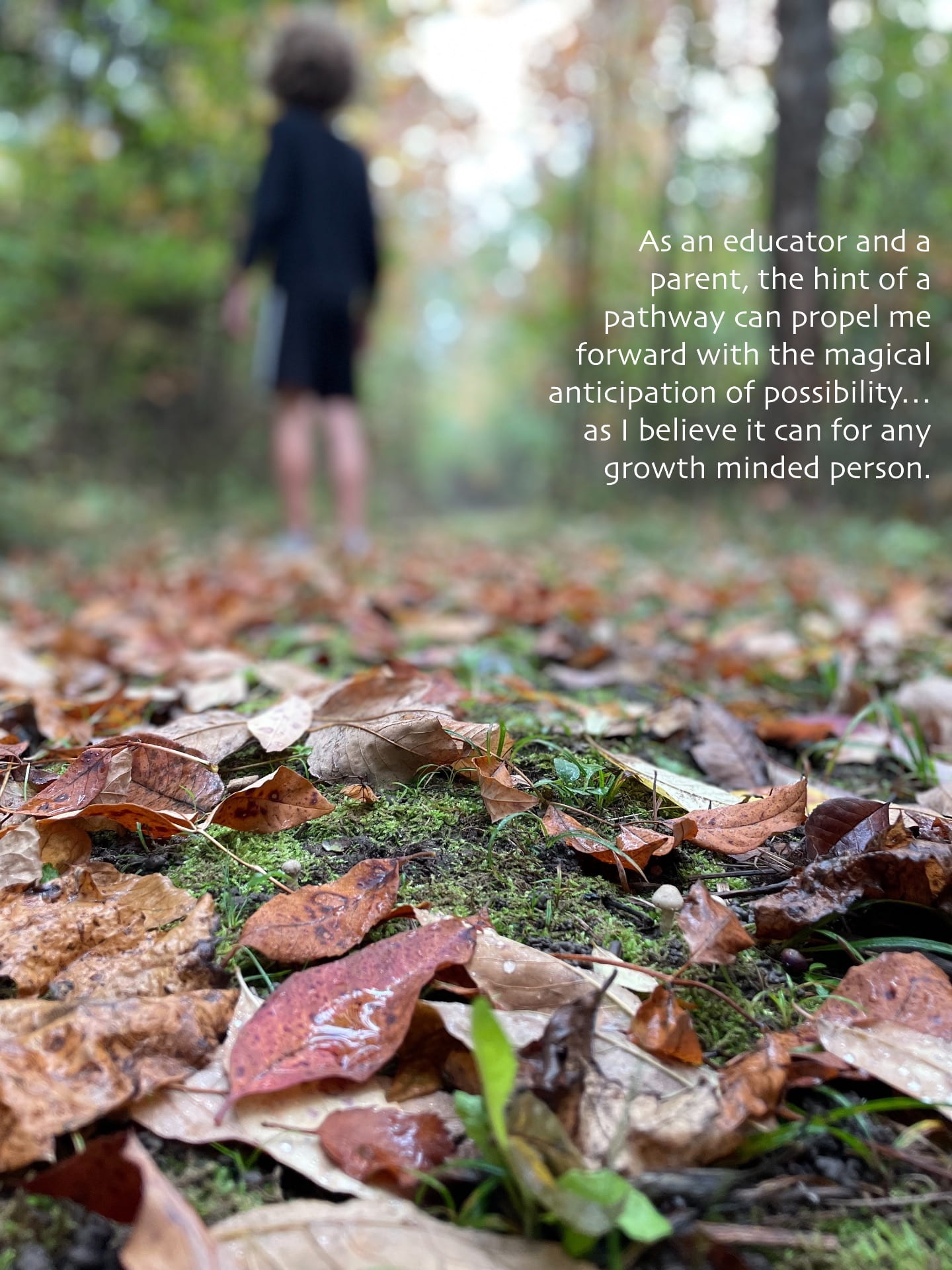
I’m getting to know the woods at the farm. Through exploration and focused interest, I’ve come to realize that a friend seems to be living there. I’m excited to meet that friend and working to do so with intentionality. It’s the same feeling I get when I discover a pathway to learning, whether it’s my own pathway or a pathway the comes to light around the learning of another. As an educator and a parent, the hint of a pathway can propel me forward with the magical anticipation of possibility…as I believe it can for any growth minded person. 

Once we’re set in motion, visions and goals can unfold. When we know that something is possible, we can shift from imagination to eventuality. One of the challenges we face with eventuality it that it can be waiting around the corner or it can surface three years from now. Either way, with patience, persistence, knowledge and faith, we can traverse any learning pathway we set out upon. 

Sometimes we see shadowy movements along the way, sometimes we get glimpses of outcomes, and sometimes we find ourselves staring at crossroads marking the end of one journey and the beginning of another. In any case, it is our job to hold true to course, bobbing and weaving with the ebbs and flows, and putting one foot in front fo the other for ourselves and the children we serve. 

Each In Our Own Way (An Equity-Based Reflection On Helping Our Children Connect With, Appreciate And Love Those Who Look, Think, And Act In Vastly Different Ways From Them)

*The names I’m using in this reflection are not the actual names of any children involved. I’m using alternate names to protect privacy. 

Confusion, Worry And Fear

A few weeks into the new school year our youngest child, a six-year-old starting first grade, came home from school with a troubled mind. I could see that he was deep in thought. As we went about our typical after school routine he presented as worried and distracted. 

Before long he asked if he could speak with me alone. We went outside together, where he began to reluctantly unfold a story of two children at his school with special needs. As he told me about the kids, tears formed in his eyes.

First he told me about being scared. In his words, he said that Brandon was aggressive on the playground. He told me that he sees Brandon approaching kids and insisting on playing with them in ways that frightened him. 

He said that Brandon gets physical with kids; that he uses his hands and his body in ways that make him nervous and uncomfortable; that Brandon communicates in ways that are different from how the typically functioning kids he’s used to playing with communicate, and that he’s worried about having to confront the potential eventuality of Brandon approaching him on the playground. In his way, he asked for permission to not have to engage with Brandon as school.

Knowing our child, I could see the internal struggle that this ask, and this need presented for him. He’s an empathic, compassionate person. I could see him wishing he didn’t feel this way, feeling bad about himself, and feeling bad for Brandon. 

My Brain Won’t Let Me 

Next he told me about Marvin. He told me that Marvin is in his class. He said he could see that Marvin needs friends but doesn’t have any. He told me he’s not scared of Marvin because Marvin doesn’t behave in ways that frighten him, but in ways that demonstrate his struggles with communication and socialization. He told me that he thinks he could be the friend Marvin needs, but that whenever he thinks about becoming Marvin’s friend, his brain won’t let him. 

No two children are the same. That said, most children’s unique qualities don’t overtly differentiate them from the group. At least not in the eyes their peers. Most children, regardless of gender, learning style, energy level, interests, developmental readiness, capacity for age-appropriate communication, and lived experiences don’t stand out in ways that make them unapproachable. Brandon and Marvin are both visibly unique from most other kids. 

As parents, guardians and educators, we can tune in to subtle and explicit differences between children. Children, with their concrete, relatively inexperienced world views, tend to be less adept at identifying subtle differences, and they tend to be hyper aware of explicit ones. 

To no fault of their own, children tend to notice when other children behave in ways that appear “out of the ordinary,” and because they don’t have the knowledge or experience to process why a peer would look and sound so different, they can easily fall into worry and even fear around socializing with kids who they identify as acutely different.

Our child’s description of the struggle he’s experiencing around wanting, and attempting to support a friend with special needs (“my brain won’t let me”), tells us a lot about a critical and persistent social emotional challenge felt by all of children.

We know that, like our child, both Brandon and Marvin need to experience genuine friendships. We know that developing genuine friendships with people who present as different from us, whether vastly or subtly, is mutually beneficial. 

We also know that diminishing classroom, school and community cultures can quickly and easily (while often unknowingly and inadvertently) be built around kids who’s communication and behavior are outside of the norm. This is an incredibly important point for parents, guardians and educators to be aware of as we work hard to listen to and guide our children around challenges that surface at school. 

When children come home with negative reports and concerns about their peers, we can help them focus on an “each in our own way” lens by exploring context with them. We can remind them that each person views the world in a unique way, based on who they are and what they’ve experienced, and that our abilities and world-views tend to guide our thoughts, feelings and actions. 

We can teach them that we’re all learning all the time, and that generally, people want to do good things and be nice. When our friends aren’t being their best selves it can often be because they don’t know how, or because they’re hurting. Sometimes it’s challenging, but patience, understanding and kindness can help.

Positive classroom, school and community cultures can lift kids up and build bridges to health and achievement, while negative classroom, school and community cultures, pointedly focused on the expressions and actions of a particular child, can deteriorate that child’s self image, limit their potential, and engrain increased worry and fear in others. 

Fortunately, as parents, guardians and educators, we have the power to perpetuate change in this area, to build paradigms of understanding around diversity, to help our children uncover the inherent foundations of compassion that exist within each of them, to drive equity, and in doing so, to enhance their lives and the world in which we all live.

Not Answers…Opportunities

When we teach our children to embrace diversity, to move toward rather than away from that which is different and/or unknown to them, to be reflective in their processing of communication and interactions with others, to consider multiple perspectives, to seek understanding (even through worry and fear), and to pull from kindness where frustration persists, we give them opportunities to expand their horizons. 

When we guide children through problem solving in any area we provide them with safe, supportive spaces to grapple with specific challenges.  When we give children safe, supportive spaces to grapple with specific challenges we provide them with experiences that can support the development of their ability to grapple with other challenges. 

Children become better problem solvers when they have our permission to work on solving the problems that are in front of them. Along with that permission, they benefit from our support, our love and our guidance.

A Solid Foundation For A Lifelong Journey

Our child continues to tell me that he’s nervous around Brandon and that he still hasn’t approached Marvin or become his friend. He also continues to tell me that he thinks he can be the friend that Marvin needs. 

The other day he told me that he thinks the first step will be introducing himself. He said, “We’ve never even met…maybe if we met we would become friends.”  He’s outlined multiple pathways to officially meeting Marvin, from asking his teacher to introduce them to approaching him on the playground. He continues to grapple and I continue to support. 

I don’t have the answers. While I hope they do, they may never become friends. I nudge but I don’t push. I listen and I affirm the reality of swirling emotions. I don’t know how to ease the intensity of those emotions or impart a sense of comfort around this or any of the multitude of difficult childhood challenges. 

I do know that every child is living a life in which developing skills of compassion, along with the skills needed to communicate, collaborate, and otherwise engage with one another, is a potential pathway to increased joy and balance for them and for those who they meet along the way. 

I know that we serve children well when we drive cultures of acceptance in our classrooms, school and communities, and aid our children in understanding that they can and should love and embrace others, even those who behave in ways that confuse and worry them. 

When we help them see that the personalities, inherent capacities and lived experiences of those around them contribute to their thoughts, feelings and actions, we help them put behavior into context and better manage their  interactions and relationships.

As with all challenging journeys, the complex pathways of supporting our children’s positive progress and well-being are long and winding, they’re sometimes shrouded in mist, and they’re often confusing. I would suggest that an “each in our own way” lens is solid foundation for achieving healthy outcomes, for them and for us.